



Regardless of your irrigation water source, UCCE farm advisor Jaime Ott emphasizes that irrigation management is Phytophthora management in the orchard.
Phytophthora is a genus of plant pathogens, with more than 200 species, several of which cause root rot, crown rot and pruning wound cankers. Phytophthora infection is caused by an aggressive pathogen taking advantage of soil saturation.
Although these pathogens can be found in surface waters, Ott’s recent study shows they also can be common in orchard soils, regardless of the source of the irrigation water used in that orchard. It is water, either standing water or saturated soils, that allows Phytophthora to infect trees, and Ott stresses that good irrigation management is crucial to prevention, no matter the water source.
When there is standing water or saturated soil in an orchard for more than 24 hours and the pathogen is present, spores move toward the tree and infect roots, causing leaf yellowing, poor vigor, lack of fine roots and eventual tree death. Symptoms are a sign of disconnect between roots and tree canopy, Ott said, as the infection restricts movement of water and nutrients.
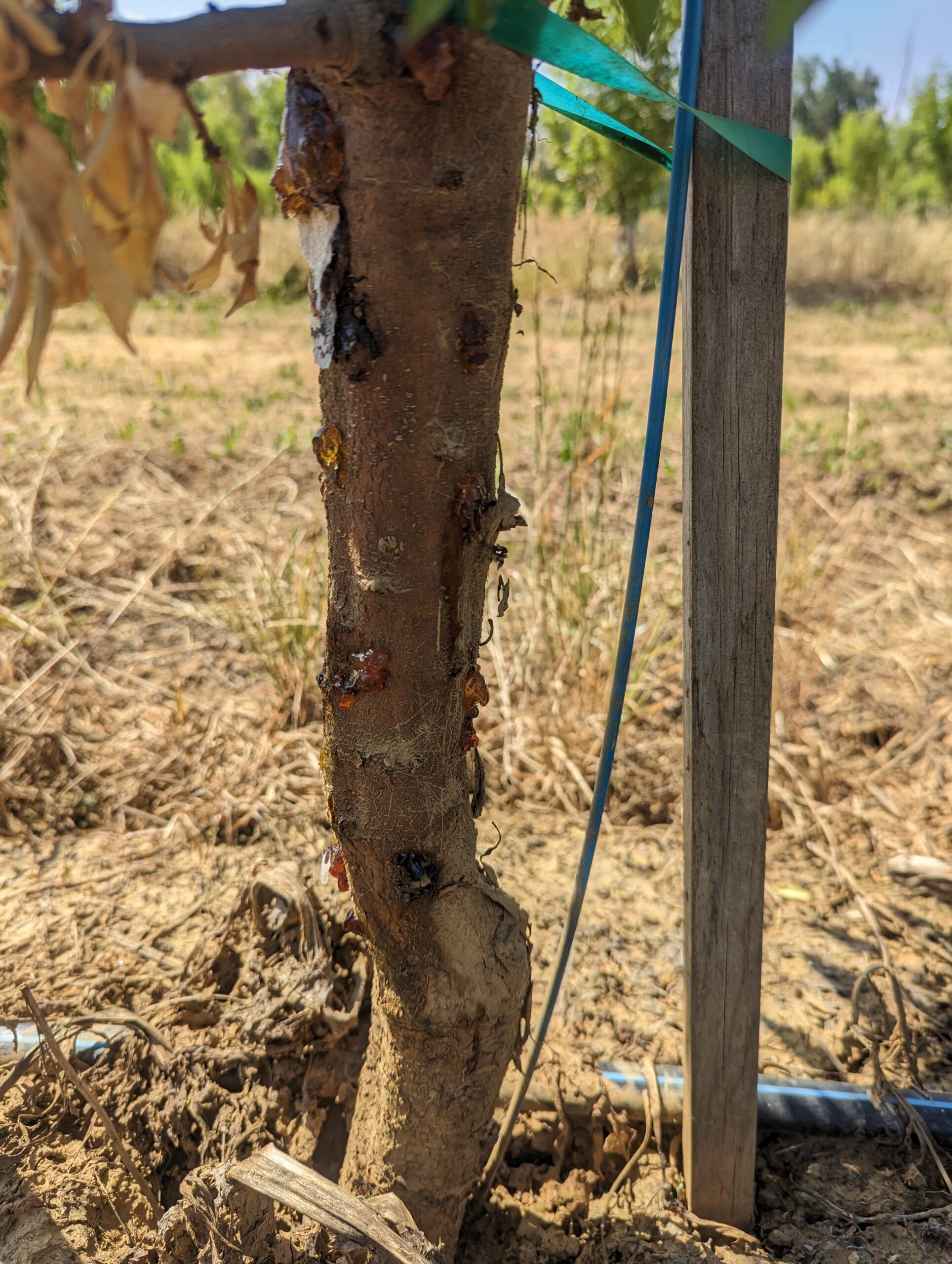
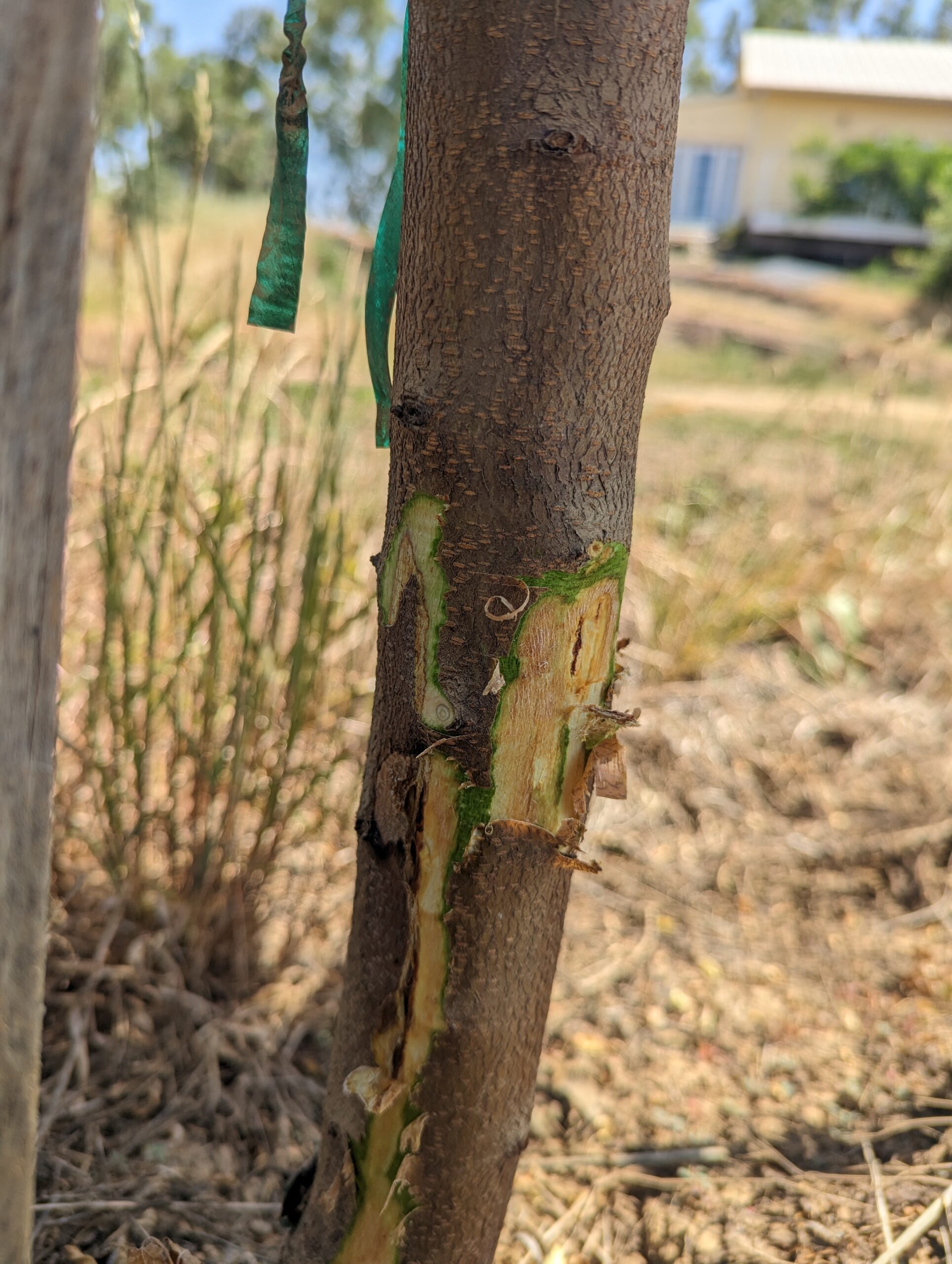
Infected tree trunks led to leaf yellowing and amber-colored gumming in almonds, dark bleeding cankers in walnuts. Trees can collapse after bud push or in warm weather. Infections can quickly kill young trees. Older trees may show symptoms over a period of time before production is affected. Once the tree is infected, symptoms can progress even without the presence of excessive water.
Waterlogging can lead to similar symptoms, but they generally improve once the excess water is gone and the tree has had a chance to regrow fine roots.
Proper Irrigation Practices Essential to Limit Disease Spread
Some key preventatives include reducing ponding with irrigation application rates that do not exceed the infiltration rate, reducing length of soil saturation with shorter, more frequent sets, and avoiding wetting tree trunks, choosing wetting patterns that avoid tree trunks and moving drip emitters away from the trunk.
Ott wrote in the UC publication Sac Valley Orchards that using resistant rootstocks can help limit Phytophthora diseases when planting new orchards or putting in replants. No rootstock is immune to Phytophthora, making irrigation management crucial.
Ott said many previous studies have shown that Phytophthora species are common in surface sources of irrigation water. Phytophthora has not been found in groundwater unless the well has been contaminated with surface water. The assumption has been that using surface water to irrigate orchards carries a greater risk of root or crown rot. Ott said in her experience, there are orchards with root or crown rot that are irrigated with groundwater and orchards irrigated with surface water that show no symptoms of these diseases.
In her study in the Stockton East Water District, Ott and collaborators Greg Browne from USDA ARS and UCCE advisor Mohamed Nouri sampled surface water irrigation sources monthly from June to October and tested for Phytophthora using DNA sequencing. She reported that nearly every testing site had at least one Phytophthora species of concern to orchards, a finding that is consistent with previous studies.
In spite of the presence of Phytophthora in the surface water used for irrigation, the trial determined that the source of the irrigation water did not affect the chances of finding Phytophthora in the soils. It also found that Phytophthora was common in orchard soils, with 32.5 percent of sampled orchards testing positive. Groundwater-irrigated orchards were as likely to have this pathogen present as orchards irrigated with surface water, indicating that surface water was not the main factor in Phytophthora infections and irrigation with surface water may not increase risk of the disease.
Ott’s study went farther, looking at whether Phytophthora in a surface water delivery system can get into an orchard via the irrigation system, given the filtration of surface water to keep emitters from plugging.
Testing water in three surface water-irrigated orchards, two with drip and one with sprinklers, and in two groundwater-irrigated orchards, Ott found that Phytophthora did reach the orchard and the sand media filter did not affect the regularity of the detection.
Ott said it is difficult to determine the source of Phytophthora in orchard soils. Historical flooding may be one answer. Infected planting material and soil on orchard equipment are other possible routes into an orchard.