



Listen to the audio version of this article (generated by A.I.)
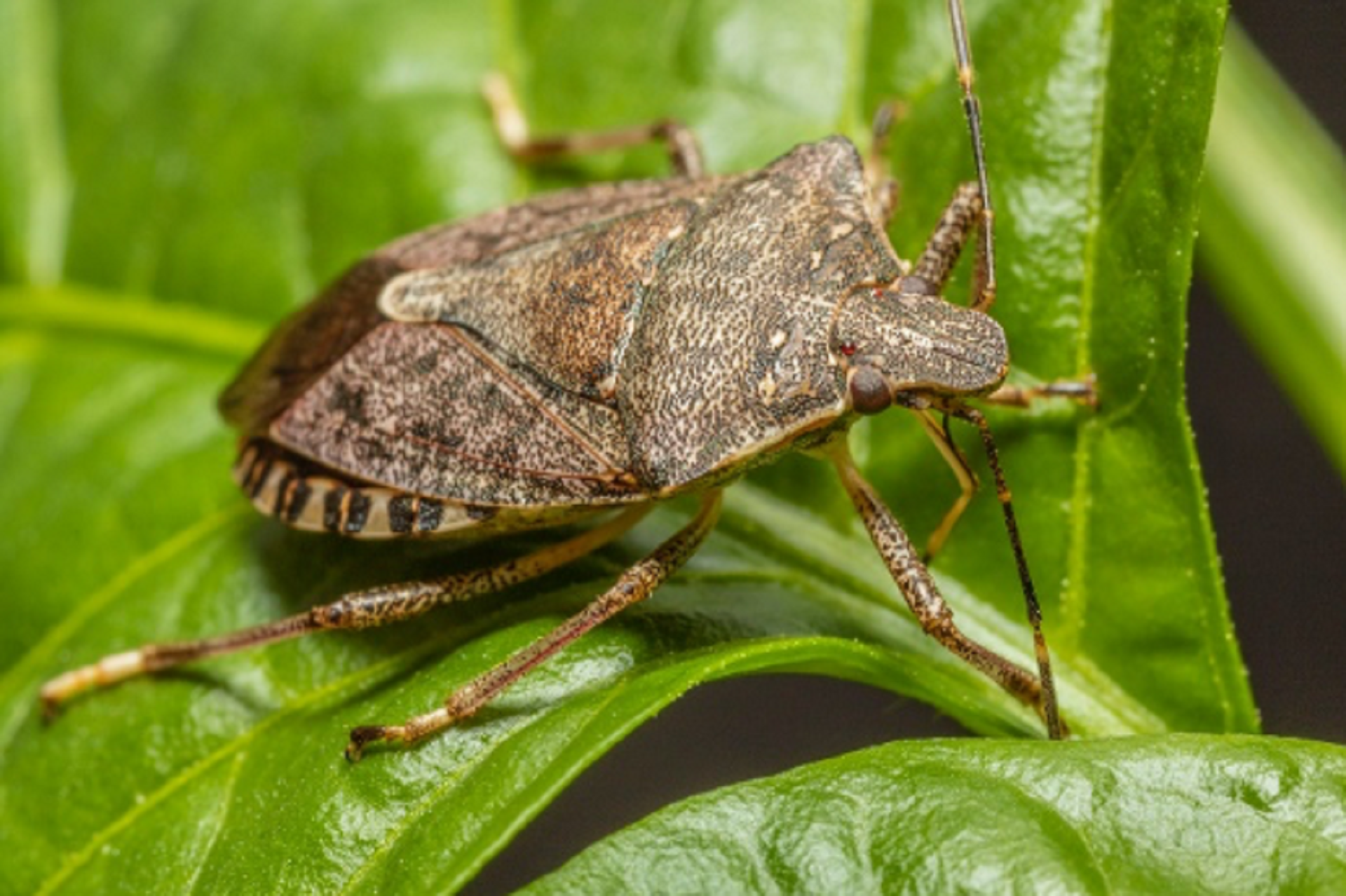
Cotton seed bug, or CSB, (Oxycarenus hyalinipennis, Hemiptera: Oxycarenidae), is a small seed-feeding bug that poses a significant invasive threat to cotton and other malvaceous crops, such as okra. It is generally regarded as being native to Africa and adjacent Mediterranean regions, from where it has spread widely through trade. From this native range, CSB has successfully invaded parts of Asia, the Middle East, Europe, South America and numerous Caribbean islands. In the early 1990s, CSB established in the Caribbean and was detected in the Florida Keys in 2010. An eradication program targeting this pest in Florida was successfully completed in 2014. The species is well adapted to warm climates and is considered a high-risk pest for U.S. cotton-growing regions in plant hardiness zones 8 to 11.
Host range and biology
CSB is primarily associated with plants in the order Malvales, especially those in the family Malvaceae. Complete nymphal development to adulthood is primarily supported on seeds of malvaceous hosts. Adult CSB, and possibly nymphs, to a lesser extent, may opportunistically use nonhost plants for shelter and moisture sources. Major reproductive hosts include upland cotton (Gossypium hirsutum), okra (Abelmoschus esculentus), various Hibiscus species, kenaf (Hibiscus cannabinus), cocoa (Theobroma cacao) and weedy mallows such as Malva and Abutilon species.
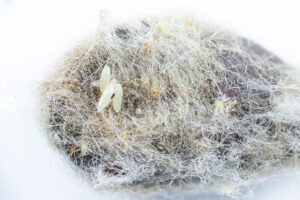
In California, CSB has also been recorded on ornamental Lagunaria species (Norfolk Island hibiscus or cow itch plant) and on seeds of native mallows, such as Abutilon palmeri (Indian mallow), Sphaeralcea species (globe mallow), and Malacothamnus fasciculatus (chaparral mallow), raising conservation concerns for native California mallows. Adults and nymphs aggregate on and inside maturing seed pods of host plants. In cotton, clusters (sometimes referred to as “swarms”) of CSB can be found inside bolls. CSB feeds by inserting needlelike stylets into seeds to ingest endosperm and embryo tissue. Eggs are typically laid in the lint around cotton seeds or inside seed pods of other host plants.
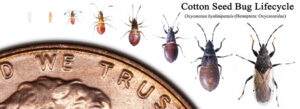
Development from egg through five nymphal instars to adult can be completed in about a month under favorable temperatures, such as 27 C (80 F). Several generations per year, possibly three to seven, may occur on suitable host seeds and favorable temperatures.
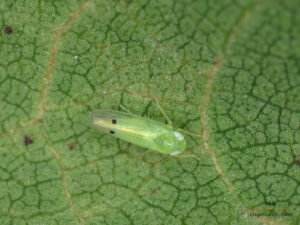
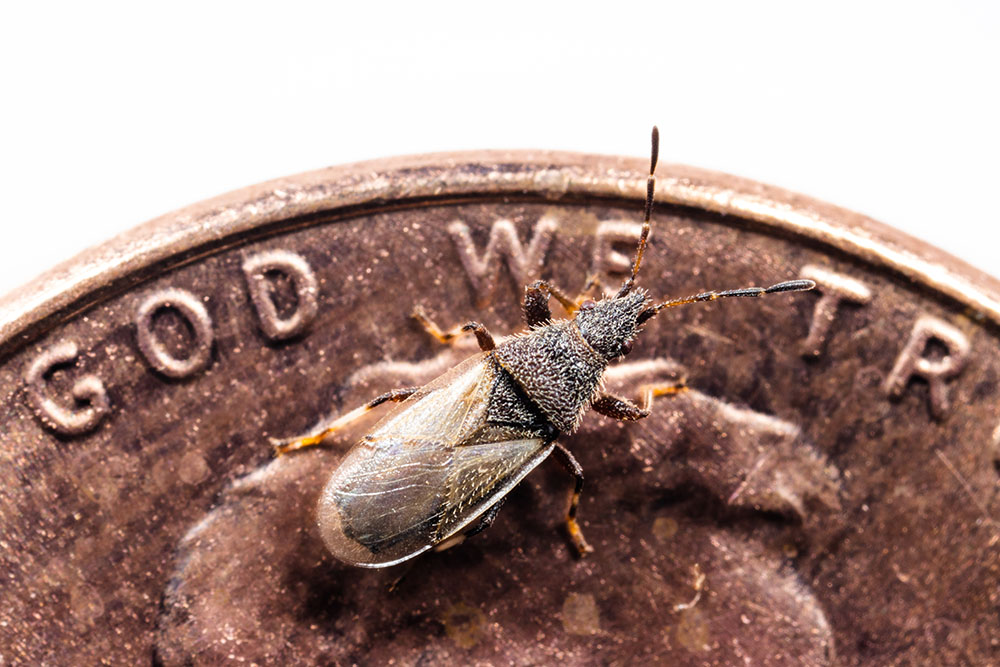
(Photo I. Esquivel, Univ. of Florida.)
Economic impacts on cotton
Globally, CSB is considered a major pest of cotton, reducing yield and quality of lint and seed. CSB feeding on cotton seeds can reduce seed weight by approximately 15%. Seed germination rates can also drop significantly, in some cases by up to 88%, which reduces stand establishment success. Additional economic losses may result from lower oil content and quality in cottonseed used for oil extraction. Fiber quality and market grade can be downgraded if lint is stained with fecal spots or reddish fluids released from crushed insects during ginning. The presence of CSB in seed lots may jeopardize market access, adding an indirect but serious economic risk for producers.
Invasion status and risk to California cotton
In California, CSB was first detected in 2019 on Abutilon palmeri in a residential area of Los Angeles County. The California Department of Food and Agriculture (CDFA) has given CSB an “A” rating, defined as an organism of known economic importance subject to quarantine regulation, exclusion, eradication, containment or other holding actions.
‘Globally, CSB is considered a major pest of cotton, reducing yield and quality of lint and seed.’
By 2021–22, subsequent CDFA-confirmed detections in urban areas indicated establishment in Orange, Riverside and San Diego counties. Genetic analyses have supported these findings. There are also credible reports, through personal communications and iNaturalist posts, of CSB in San Bernardino, Ventura, Santa Barbara and Santa Clara counties. However, CSB is sometimes confused with the false chinch bug (Nysius species, Hemiptera: Lygaeidae). Both are small, aggregate-forming bugs. False chinch bugs are generally grayish brown, while CSB is black with a reddish abdomen. Their host plants differ: false chinch bugs favor cruciferous weeds, such as invasive mustards.
While CSB is established in some urban areas, it has not yet been detected in commercial cotton fields, despite targeted surveys by CDFA in major cotton-producing counties in the Central Valley, including Fresno, Kern, Kings, Merced and Tulare. However, proximity to cotton acreage, especially in Riverside County, makes the threat credible. Confirmed detections in San Diego nurseries in September 2025 increase the risk of long-distance accidental introductions to new areas. No other U.S. states have reported CSB to date.
Population dynamics in Southern California
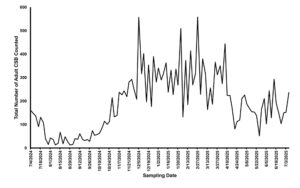
Little is known about the population dynamics of CSB in California. Biweekly surveys of Lagunaria seed pods on the UC Riverside campus indicate adult CSB densities increase from October through December, remain steady through March, and decline from April to September before rising again in October.
Natural enemies have been surveyed, with limited findings. Generalist predators such as jumping spiders, sac spiders, pirate bugs (Buchananiella continua), green lacewing larvae (Chrysoperla species) and leafhopper assassin bugs (Zelus renardii) were found infrequently. Lab bioassays confirmed that all six predators fed on at least one CSB life stage, and two, jumping spiders and green lacewing larvae, fed on all stages. However, predator populations were consistently low and did not increase in response to CSB density, providing little measurable control.
Insecticide options
Control is challenging due to CSB’s feeding inside seed pods and cotton bolls. The bug also aggregates in protected sites and overwinters in crop and weed debris.
Insecticides that have shown efficacy against CSB nymphs and adults, and are or have been registered for use in cotton, include:
• Avermectins (abamectin)
• Pyrethroids (bifenthrin, deltamethrin, lambda-cyhalothrin)
• Organophosphates (chlorpyrifos, dimethoate, malathion)
• Neonicotinoids (imidacloprid, thiamethoxam, clothianidin)
• Carbamate/IGR mixes (methomyl and diflubenzuron)
• Spinosyns (spinosad)
• Botanicals (neem oil)
Recent lab studies evaluated 13 formulations. Six, including acephate, dinotefuran, flupyradifurone and imidacloprid, showed efficacy. Insecticide programs targeting pests that damage cotton bolls, such as cotton bollworm (Helicoverpa zea), may also help reduce CSB seed exposure, but repeated applications could increase resistance pressure.
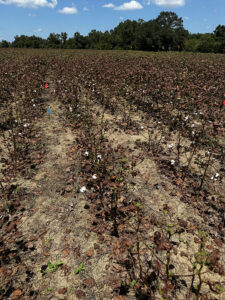
Resistance development
Lab-selected and field populations of CSB show heritable resistance to multiple chemistries, including imidacloprid, fipronil, organophosphates, pyrethroids, spinosad, emamectin benzoate, chlorfenapyr and nitenpyram. Resistance management must include regular susceptibility monitoring, rotation among classes with different modes of action, and judicious insecticide use.
Cultural and sanitation strategies
Cultural controls are recommended to reduce overwintering populations. These include destroying crop residues (stalks, bolls and leaves) through tillage or mulching, removing weeds and alternate hosts, and reducing field-edge refuges. Early picking of cotton bolls may limit exposure time. Covering seed bins before ginning can prevent infestation by flying adults and reduce the risk of spreading CSB to new areas.
Cotton jassid: Another emerging threat
Cotton jassid (Amrasca biguttula, Hemiptera: Cicadellidae) is another pest of concern. Widespread in Asia and newly established in Puerto Rico (2023) and Florida (2024), it spread across the southeastern U.S. by 2025. This pest damages upland cotton at densities of 30 or more per leaf and has a broad host range, including peanuts, soybeans, sunflowers, eggplant, potatoes and ornamental hibiscus.
With both cotton seed bug and cotton jassid now in the U.S., it is increasingly likely they will co-occur in production regions. Existing IPM programs will need to be adapted to address these new threats. Localized strategies and strong extension support will be essential for sustainable management.
References
Adachi-Hagimori, Triapitsyn SV, Uesato T. 2020. Egg parasitoids (Hymenoptera: Mymaridae) of Amrasca biguttula (Ishida) (Hemiptera: Cicadellidae) on Okinawa Island, a pest of okra in Japan. Journal of Asia Pacific Entomology 23: 791-796. https://doi.org/10.1016/j.aspen.2020.07.008
CAPS. 2023. Oxycarenus hyalinipennis. https://caps.ceris.purdue.edu/wp-content/uploads/2025/07/Oxycarenus-hyalinipennis-CAPS-datasheet_20230522.pdf (accessed 24 Nov. 2025)
CDFA 2019. California pest rating profile for Oxycarenus hyalinipennis (Costa): cotton seed bug Hemiptera: Oxycarenidae Pest Rating: A https://blogs.cdfa.ca.gov/Section3162/wp-content/uploads/2019/07/PRP2019-Oxycarenus_Profile_ADA.pdf (accessed 25 Nov. 2025)
Dueñas-López, MA. 2022. Oxycarenus hyalinipennis (cotton seed bug). CABI Compendium
38170 https://doi.org/10.1079/cabicompendium.38170 (accessed 24 Nov. 2025).
Halbert SE, Dobbs T. 2010. Cotton seed bug, Oxycarenus hyalinipennis (Costa): A serious pest of cotton that has become established in the Caribbean Basin. Pest Alert: Florida Department of Agriculture and Consumer Services, Division of Plant Industry. DACS-P- 01726. https://ccmedia.fdacs.gov/content/download/9773/file/oxycarenus-hyalinipennis.pdf (accessed 24 Nov. 2025)
Hoddle, CD and MS Hoddle. 2023. Cotton seed bug: another invasive pest that has established in California. CAPCA Adviser 26(1): 34-38.
Ijaz M, Shad SA. 2018. Inheritance mode and realized heritability of resistance to imidacloprid in Oxycarenus hyalinipennis Costa (Hemiptera: Lygaeidae). Crop Protection 112: 90-95. https://doi.org/10.1016/j.cropro.2018.05.015
Irshad M, Salem MM, ul ain Hanif Q, Nasir M, Asif MU, Shamraiz RM. 2019. Comparative efficacy of different insecticides against dusky cotton bug (Oxycarenus spp.) under field conditions. Journal of Entomology and Zoology Studies 7(2): 125-128.
Shogren, C. 2023. Oxycarenus hyalinipennis scorecard. https://calinvasives.ucdavis.edu/scorecard/oxycarenus-hyalinipennis-scorecard?utm_source=chatgpt.com (accessed 25 Nov. 2025)
Texas Department of Agriculture. 2025. Cotton Jassid – Two-Spot Cotton Leafhopper (Amrasca biguttula). https://texasagriculture.gov/Regulatory-Programs/Plant-Quality/Pest-and-Disease-Alerts/Cotton-Jassid-Two-Spot-Cotton-Leafhopper (accessed 4 December 2025).
Ullah S, Shad SA, Abbas N. 2016. Resistance of dusky cotton bug, Oxycarenus hyalinipennis Costa (Lygaidae [sic]: Hemiptera), to conventional and novel chemistry insecticides. Journal of Economic Entomology 109: 345-351. https://doi.org/10.1093/jee/tov324
USDA-APHIS. 2021. Technical Bulletin- Oxycarenus hyalinipennis (Costa) (Hemiptera: Oxycarenidae) cotton seed bug. https://ccgga.org/wp-content/uploads/2021/09/Cotton-Seed-Bug-Technical-Bulletin.pdf (accessed 25 Nov. 2025)
USDA-APHIS. 2024. Pest alert: Cotton seed bug (Oxycarenus hyalinipennis). United States Department of Agriculture, Animal and Plant Health Inspection Service, Plant Protection and Quarantine. Available from: https://www.aphis.usda.gov/sites/default/files/alert- cotton-seed-bug.pdf (accessed 25 Nov. 2025)
Wazir S, Shad SA. 2022. Development of fipronil resistance, fitness cost, cross-resistance to other insecticides, stability, and risk assessment in Oxycarenus hyalinipennis (Costa). Science of the Total Environment 803: 150026. https://doi.org/10.1016/j.scitotenv.2021.150026
Zilnik, G, JR Hepler, P Merten, IX Schutze, CD Hoddle, MS Hoddle, PC Ellsworth, and C Brent. 2025. Screening of insecticides for management of the invasive Oxycarenus hyalinipennis Costa (Hemiptera: Oxycarenidae) population sourced from urban southern California. Journal of Economic Entomology 118(2): 692-699. https://doi.org/10.1093/jee/toaf014

Mark S. Hoddle
Christina D. Hoddle | Research specialist, Department of Entomology, University of California, Riverside