

Listen to the audio version of this article (generated by A.I.)
The California Department of Pesticide Regulation (DPR) has announced plans to expand its statewide Air Monitoring Network (AMN). DPR released a proposal detailing plans to expand from five to 10 long-term air monitoring stations and add a new mobile platform to better assess pesticide concentrations in agricultural communities. The department is holding a 60-day public comment period to seek input on proposed locations for new air monitoring stations and will host a virtual public workshop on April 14 to discuss the proposal. DPR’s Air Monitoring Program was initiated in 2011 and currently collects and analyzes data in Merced, Ventura, Santa Barbara, Kern and Monterey counties. More specifically, the five existing sites are in Delhi (Merced County), Oxnard (Ventura County), Santa Maria (Santa Barbara County), Shafter (Kern County) and Watsonville (unincorporated Monterey County).
Expansion Plans and New Monitoring Sites
The 2024-25 state budget provides permanent funding to DPR to expand ambient air monitoring to a total of 10 stations. DPR used an updated, data-driven prioritization process to identify five counties, Tulare, Stanislaus, Imperial, Siskiyou and San Joaquin, as leading candidates for four new AMN stations. To reach a total of 10 full air monitoring sites, DPR’s expansion plan builds on five existing AMN stations to include:
• Conversion of an existing site providing limited pesticide sampling to a full monitoring station in Fresno County
• Up to four (4) new AMN stations in prioritized counties
• New mobile monitoring station to add capacity for additional studies
The Fresno County site is in Parlier, which was established in 2016 for the monitoring of 1,3-D alone. This station is DPR’s only long-term monitoring location that is not located at a school site. Relocation of the Parlier station to a school and expanding monitoring to all 40 chemicals would integrate Fresno County into the AMN.
‘The outcome of this process is a ‘short list’ of communities where stations may be ideally situated to collect data regarding potential pesticide exposure.’
How Sites Are Selected
For the other four sites, CDPR will follow a site selection procedure to evaluate communities across the state. This process is updated with new data every 3 to 6 years and informs decisions on potential stations to be added to the monitoring network. Through this process, communities in the state are ranked from highest to lowest based on their proximity to fumigant and organophosphate applications. Fumigants are prioritized because they are used in large amounts and readily enter the gas phase, while organophosphate pesticides are both widely used and share a common biological mechanism which can produce an additive effect in terms of their toxicity, presenting a greater potential health hazard than non-fumigant, non-organophosphate pesticides.
While not part of the formal prioritization procedure, historical use of non-fumigant, non-organophosphate pesticides may be considered when deciding between otherwise similar monitoring locations. Because the site prioritization process develops independent rankings of the top 50 communities based on either organophosphate or soil fumigant usage, the outcome of the site prioritization process is a list of up to 100 communities. In practice, some communities may appear on both lists, lowering the total below 100, while selection for communities containing schools and regions containing more than a single high-ranking site further reduces the total. Therefore, the outcome of this process is a “short list” of communities where stations may be ideally situated to collect data regarding potential pesticide exposure.
Monitoring Requirements and Next Steps
Once a community is selected for monitoring, an appropriate location must be found within a selected community that satisfies certain requirements to ensure that results are representative of the ambient air. DPR evaluates prospective monitoring locations and periodically reevaluates existing monitoring locations to ensure they comply with U.S. EPA’s ambient air siting criteria. Monitoring sites must meet the following minimum criteria:
• 2 to 15 meters above the ground
• At least 1 meter horizontal and vertical distance from supporting structures
• At least 20 meters from trees
• Distance from obstacles should be at least twice the obstacle height
• Unobstructed air flow for at least 270 degrees
• Sites must also satisfy certain access requirements including:
o Accessibility of the site to sampling personnel at the time of sampling
o Availability of electricity
o Protection of equipment from loss or tampering
‘This process produces a ‘short list’ of communities best suited for monitoring potential pesticide exposure.’
According to CDPR, DPR scientists evaluate prospective sites to make sure they meet the above requirements prior to equipment installation. If no acceptable sites can be found within a selected community, or if DPR cannot identify cooperators to host the site, then an alternative community must be considered.
After the initial evaluation, CDPR generated a list of 71 unique communities distributed across 14 counties. After further analysis reviewing existing sites and distances from these sites, the list has been reduced to 29 communities across five counties including Stanislaus, San Joaquin, Imperial, Siskiyou and Tulare. CDPR then ranked the counties based on the number of high-ranking communities within each county and came up with the following ranking:
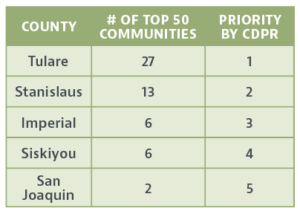
CDPR is considering comments through May 11 and is asking for feedback on the ranking of the counties and which of the communities within each county should be the target sites for the air monitoring network. It might also be important to weigh in on how the mobile monitoring station will be utilized and how CDPR will ensure it also meets the EPA siting criteria.
