

Listen to the audio version of this article (generated by A.I.)
Lettuce Fusarium Wilt Fusarium wilt has become one of the most challenging diseases for California lettuce growers. Once established, the fungal pathogen that causes this disease, Fusarium oxysporum f. sp. lactucae, persists in production soils indefinitely, increasing its abundance by growing on suitable hosts. In the case of this forma specialis, or special form of the fungus, its favored host is lettuce. The fungal spores spread easily between fields, primarily through infested soils on equipment. As a vascular disease that infects through plant roots, it disrupts water and nutrient transport, often leading to unmarketable heads or dead plants (Gordon and Koike 2015). Because the pathogen can persist in soil and be moved during cultivation and field preparation, it often passes unnoticed through rotations with other crops, allowing small hotspots to expand into fieldwide problems once susceptible lettuce is planted again.
Fusarium oxysporum pathogens are notorious for developing genetic variations that allow them to overcome cultivar resistance (Edel-Hermann and Lecomte 2019). In California, there has been growing evidence of new variants, causing concern that management is becoming increasingly challenging (Nayak et al. 2025). At the same time, fumigation and other conventional chemical options are either restricted, ineffective or economically impractical. A rapidly expanding market of soil-applied biological products marketed for Fusarium wilt suppression, soil health, and improved crop resilience has stepped into this gap.
The Promise of Biological Products in Disease Management
Fusarium wilt has become an attractive target for an industry of soil-applied biological products often referred to as “biologicals.” Some of these products are formulations of one or more microbial species that have the potential to colonize plant roots, protecting them from pathogens while providing numerous other benefits such as improved nutrient acquisition and abiotic stress tolerance. While many of these microbes and their potentially beneficial roles in soil or plant health have been well documented in scientific literature, the question lies in whether their isolation, commercial formulation and augmentation into production agricultural soils can lead to the same benefits across a variety of crops, advancing sustainably and providing a return on investment for growers.
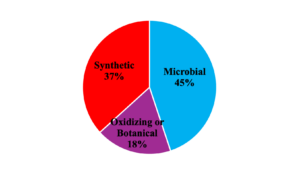
In response to grower demand for research on the efficacy of these products, we wanted to test those claims under increasingly realistic production conditions to determine whether commercial soil-applied biologicals provide Fusarium wilt suppression on iceberg lettuce when scaled from greenhouse trials to small-plot experiments and ultimately to commercial lettuce fields. Most products evaluated in our study were based on commercial formulations of biologicals, predominantly bacteria, fungi or microbial consortia, and were marketed either as registered biofungicides, claiming a pest suppressive effect, or biostimulants, only claiming plant health improvements. In addition, we tested an oxidizing product and a botanical product, both of which are National Organic Program-compliant and work by directly suppressing the pests. In practice, growers apply these products with the expectation that they will either directly suppress Fusarium wilt or indirectly reduce losses by improving root health or overall plant vigor. Whether those expectations are realistic under commercial conditions remains an open and important question.
What We Found
Initial greenhouse disease suppression trials were conducted under artificially introduced inoculum pressure to determine whether nine different products, including microbial biofungicides consisting of single-species bacteria, multi-species bacterial blends and a fungal-based Trichoderma product, could reduce Fusarium wilt development under controlled conditions. These greenhouse trials also evaluated a botanical cinnamon oil and an oxidizing agent composed of hydrogen peroxide and peroxyacetic acid.
In these trials, the disease developed rapidly on the susceptible iceberg lettuce cultivar, and no biological or low-risk product consistently reduced disease severity relative to untreated diseased controls. The subsequent small-plot field trials narrowed the focus strictly to biological-based programs, utilizing single- and multi-species bacterial and fungal products, as well as a mixed formulation containing both. To establish a performance benchmark across both research settings, the synthetic FRAC 12 fungicide, fludioxonil, was included as a positive control. Ultimately, results from the small-plot trials were similar; disease incidence and mortality increased over time across all treatments, and no product, including fludioxonil, provided substantial suppression of Fusarium wilt.
Cost Considerations
In consulting with growers on product selection for the production field trials, cost emerged as one of the most important considerations when selecting products to test, particularly given the narrow margins under which lettuce is often produced. We collected estimates from local distributors or manufacturer representatives and found that the products we were considering varied widely in cost per acre, depending on product type and rates required to complete a labeled or recommended program on lettuce. Products containing the fungus Trichoderma sp. as the primary active ingredient stood out as more expensive compared to the bacterial-based products, with programs ranging from $145 to $450 per acre, whereas bacterial-based programs tended to fall around $50 per acre. With such a wide selection of products on the market, additional considerations for concentration of active ingredients, many of which are based on similar microbial species, viability, and ease of application based on formulation should be made.
Where it Matters Most: Production Scale Field Trials
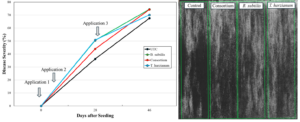
Commercial-scale trials conducted in Santa Maria, CA, provided the most representative assessment of product performance. Four treatments included: 1. Untreated control, 2. Bacillus subtilis QST 713, 3. a biostimulant blend of Rhodopseudomonas palustrus and Bacillus spp., and 4. Trichoderma harzianum T-78. They were applied through the drip irrigation water on roughly three-acre strips per treatment across three fields that had a known history of lettuce Fusarium wilt. Application timing included an initial application at seeding, a second application one week later, and a final application three weeks after seeding. This protocol was replicated across three iceberg lettuce field blocks within the same ranch, and each block was approximately 12 acres. Although all three field blocks were known to be infested, disease severity was only high enough for measurement in one field due to the use of a susceptible cultivar in that field.
Within that field, no soil-applied biological consistently reduced Fusarium wilt losses relative to untreated areas, which ultimately led to the early termination of the crop due to extensive mortality. The overall pattern was clear: the efficacy often suggested in promotional materials was not reflected in our findings at any scale. From controlled greenhouse trials through commercial-scale production, no soil-applied treatment provided reliable Fusarium wilt suppression.
What These Results Mean for Growers
Across greenhouse trials, replicated small-plot field trials, and commercial lettuce field trials, soil-applied biological products did not provide control of lettuce Fusarium wilt. This does not suggest that biologicals lack value in specialty crop production, as many growers have observed benefits in specific crops. However, these results align with those of other academic researchers who have tested similar products for lettuce Fusarium wilt management in California, indicating that current products are unlikely to function as stand-alone solutions for management of lettuce Fusarium wilt, particularly under high disease pressure (Wang 2025, LeBlanc 2024). Integrated management approaches that emphasize cultivar selection, planting timing, crop rotation, sanitation, and sound agronomic practices remain the most reliable tools for reducing disease risk. Biological products may contribute to incremental benefits under specific conditions, but their use should be informed by independent field data and realistic expectations regarding disease suppression and return on investment.
More broadly, these findings emphasize the importance of context when evaluating biological products and integrating them into disease management programs. Unlike traditional agricultural inputs, biological products are living systems, and their performance can be strongly influenced by how they are handled prior to application, how and when they are applied, and the soil and environmental conditions into which they are introduced. Factors such as soil type, moisture, temperature, cropping history, and existing microbial communities can all affect whether a product establishes, persists or provides any measurable benefit. As regulatory and market pressures continue to encourage adoption of lower-risk inputs, there is a growing need for research that defines where, when, and how biological products are most likely to provide value. Continued investment in field-scale research, improved diagnostics, and clearer performance benchmarks will be essential for advancing Fusarium wilt management. With better alignment between product claims, agronomic context, and independent data, biologicals can be more effectively positioned as components of integrated disease management systems.
Acknowledgements
This material is based upon work that is supported by the National Institute of Food and Agriculture, U.S. Department of Agriculture, under award number G223-25-WA509 through the Western Sustainable Agriculture Research and Education program under project number GW25-008. USDA is an equal opportunity employer and service provider. Any opinions, findings, conclusions, or recommendations expressed in this publication are those of the author(s) and do not necessarily reflect the view of the U.S. Department of Agriculture.
Evan Tamayo is also a recipient of the 2024–2025 CSU ARI-NEXTGEN Student Fellowship. We thank ARI for partial funding of this work.
Additional support:
Grimm Family Center for Organic Production and Research
Aerial Imagery conducted by aerialPLOT: Kaitlin Rim
Research Assistants: Jenna Keller, Skye Reading, Arlo Grieshop, and Samantha Buie
Farm Management: Jim Green, Brandon Sanders, and Ernie Ford
Christophor Height for consulting on the project
References
Edel-Hermann, V., and Lecomte, C. 2019. Current Status of Fusarium oxysporum Formae Speciales and Races. Phytopathology® 109:512–530. https://doi.org/10.1094/PHYTO-08-18-0320-RVW.
Gordon, T. R., and Koike, S. T. 2015. Management of Fusarium wilt of lettuce. Crop Protection 73:45–49. https://doi.org/10.1016/j.cropro.2015.01.011.
Nayak, S., Richardson, K. L., Putman, A. I., LeBlanc, N. R., Martin, F. N., Li, N., and McCreight, J. D. 2025. Detection of novel pathogenic variants of Fusarium oxysporum f. sp. lactucae in California. Plant Pathology 74:295–307. https://doi.org/10.1111/ppa.14019.
LeBlanc, N. 2024. Application of soil amendments for improved soil health and management of fusarium wilt of lettuce. https://calgreens.org/wp-content/uploads/2024/12/CLGRP_2024_FinalReport_LeBlanc.pdf
Wang, Y. 2025. Field evaluation of fungicide for controlling lettuce Fusarium wilt https://ucanr.edu/sites/default/files/2025-02/407525.pdf

Evan Tamayo | MS Student, Plant Protection Science, Cal Poly San Luis Obispo
Josue Diaz | Lab Manager, Betteravia Farms
Max Youngren | MS Student, Plant Protection Science, Cal Poly San Luis Obispo
Matthew Grieshop | Director, The Grimm Family Center for Organic Production and Research at Cal Poly San Luis Obispo