

Listen to the audio version of this article (generated by A.I.)
Can almond growers reduce fertilizer application rates without sacrificing yields? That’s the question many are asking as they navigate rising input costs, tightening water allocations and increasing pressure to demonstrate sustainable practices. But the challenge goes beyond reducing application rates, it’s determining whether nutrient formulation, availability and uptake efficiency matter more than total volume applied.
Seven years of field research in California’s Central Valley examined this question through controlled trials comparing conventional and reduced-rate fertility programs.
Why Nutrient Formulation Matters in Almond Production
Potassium and phosphorus represent critical nutrients for almonds throughout the growing season. Deficiencies limit plant growth and yield, but overapplication creates its own problems. Excess potassium can leave behind residual salts and chlorides, damaging soil health and tying up nutrients, while too much phosphorus can tie up zinc and other nutrients. Delivering the right amount of nutrition at the right time is key to a successful growing season.
Trial Design and Methodology
To understand whether growers could obtain the same yield with lower application rates, AgroLiquid worked with Bisabri Research to conduct two multiyear almond trials in Westley, California. The trials, which ran from 2018 to 2021 and from 2022 to 2024, compared almond yield and return on investment (ROI) between the grower standard and high-efficiency liquid potassium and phosphorus products.
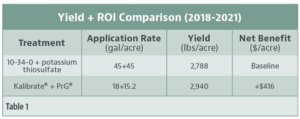
The initial trial, conducted from 2018 to 2021, tested 10-34-0 and potassium thiosulfate (45 gallons per acre each) against liquid phosphorus (18 gallons per acre) and potassium (15.2 gallons per acre).
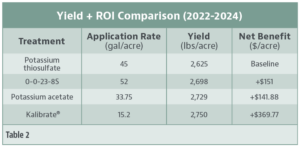
The second set of data, collected from 2022 to 2024, focused on evaluating different potassium-based treatments against a potassium thiosulfate control. This trial included four distinct treatments:
• Potassium thiosulfate
(45 gallons per acre)
• 0-0-23-8S
(52 gallons per acre)
• Potassium acetate
(33.75 gallons per acre)
• Liquid potassium
(15.2 gallons per acre)
How Reduced-rate Applications Impacted Yields
Results showed consistent patterns across both trial periods:
• In the 2018–21 trial, the reduced-rate combination improved yields
by 152 pounds per acre over the grower standard.
• In the 2022–24 trial, the liquid potassium program delivered the highest yield, achieving 2,750 pounds per acre with only 15.2 total gallons applied, compared to 2,625 pounds per acre from the 45-gallon potassium thiosulfate control.
These findings demonstrate that customized nutrient plans, built upon complete soil analysis reviewed by expert agronomists, can lead to measurable differences in nut production, resulting in higher yields and improved ROI for almond growers.
The Economic Returns of Reduced-rate Programs
Both reduced-rate programs generated higher returns through increased production — $416 and $369.77 per acre, respectively — based on a $2.50 per pound almond value. These figures reflect only direct yield value and do not account for potential operational savings from reduced application volumes, including lower labor costs and decreased fuel consumption.
‘Trials showed an average 124-pound per acre yield advantage for the reduced-rate program, despite application volumes that were consistently 46 percent lower.’
Crop Nutrition Considerations for Growers
The research establishes three critical principles growers should consider when building a nutrient management program:
1. Formulation matters as much as rate. Nutrient form and delivery method influence how much nutrition reaches the plant. In alkaline Central Valley soils, formulations that minimize phosphorus fixation and potassium binding deliver more available nutrition at lower application rates.
2. Soil chemistry drives program design. Using soil tests to understand pH, cation exchange capacity and existing nutrient levels helps determine which products will perform most efficiently in specific conditions.
3. Economic returns don’t correlate with application volume. Across seven years, trials showed an average 124-pound per acre yield advantage for the reduced-rate program, despite application volumes that were consistently 46 % lower than conventional programs.
What These Results Mean for California Almond Growers
The trial results remained consistent over the seven-year research period across varying market conditions and growing seasons, suggesting the principles apply broadly across California almond production regions with similar soil chemistry.
For growers facing pressure to reduce input costs while maintaining productivity, the research indicates that nutrient availability and formulation chemistry warrant equal consideration to total application rates when designing fertility programs.
